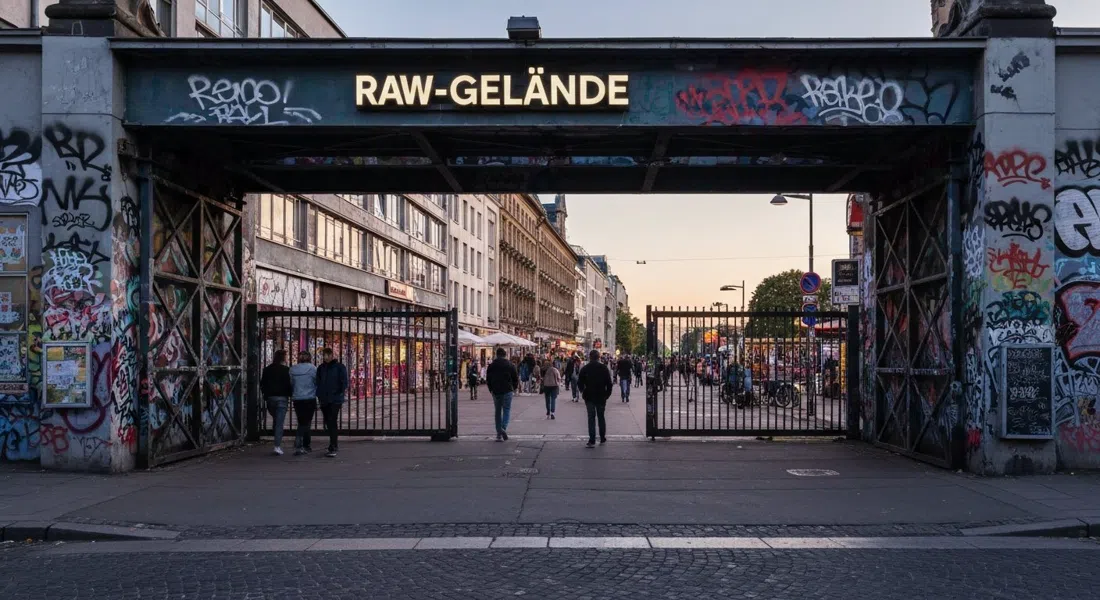
Come out of Warschauer Straße station on a Friday night and the district announces itself before you’ve even found your bearings: the M10 tram rattling past, the graffiti-slathered gates of the RAW-Gelände off to one side, and a river of people drifting towards Revaler Straße with that purposeful, slightly sleepless look you only get in a neighbourhood that has decided the weekend is an elastic concept.
Friedrichshain is old East Berlin that never got tidied up. It wears its history in layers: GDR boulevards, painted Wall segments, warehouse culture, cheap food, and the kind of nightlife that keeps the pavements busy long after the bakeries should have been the only thing open. It is young, loud and unbothered, but not in a glossy, self-consciously cool way. The place still has friction. Students, artists, expats and club pilgrims share streets lined with political murals, döner counters and third-wave coffee bars, and somehow the mix still feels unpolished enough to be interesting.
What Friedrichshain is known for
Three things define Friedrichshain: the Wall, the clubs, and the RAW. Start with the East Side Gallery, because you can’t really talk about this district without talking about that 1.3km stretch of painted concrete running along the Spree. It is the longest surviving section of the Berlin Wall, turned into an open-air gallery after the border fell, with 118 artists from 21 countries painting it in the wake of 1989 and its opening in September 1990. It’s free, unfenced and walkable around the clock, which is part of why it still feels less like a monument than a living edge — a place you can drift along at dawn, with the river on one side and the city waking up on the other.
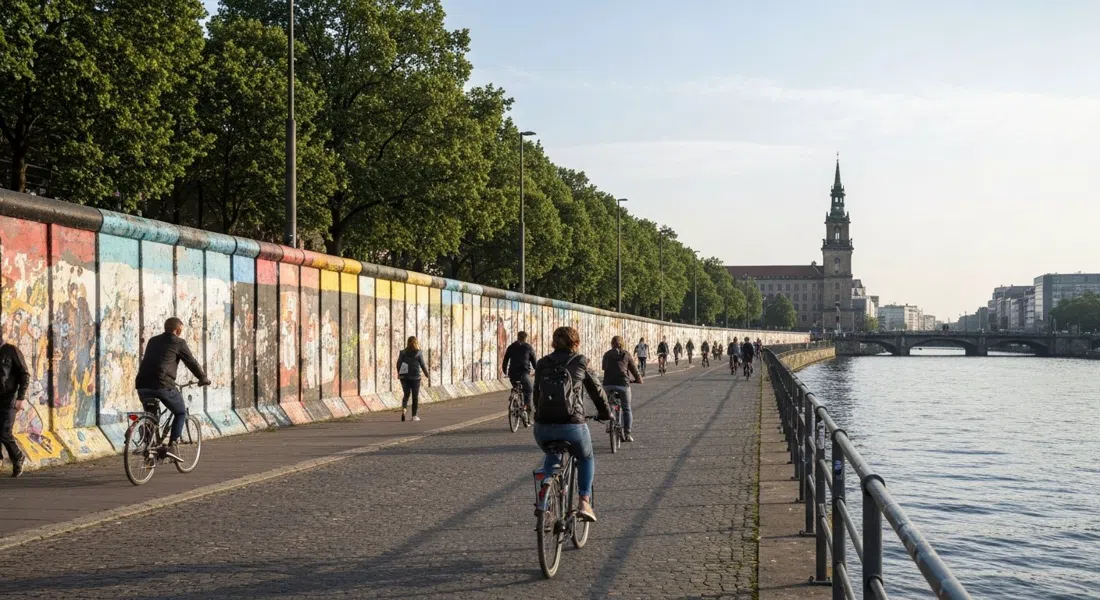
Everyone photographs Dmitri Vrubel’s “Fraternal Kiss”, the famous Brezhnev-and-Honecker mural, and yes, it deserves the attention. But the real pleasure is in the walk itself: the changing faces, the odd pauses, the way a piece of Cold War history can be both solemn and extremely photogenic in the same breath. Go early if you want the wall without the coach crowds.
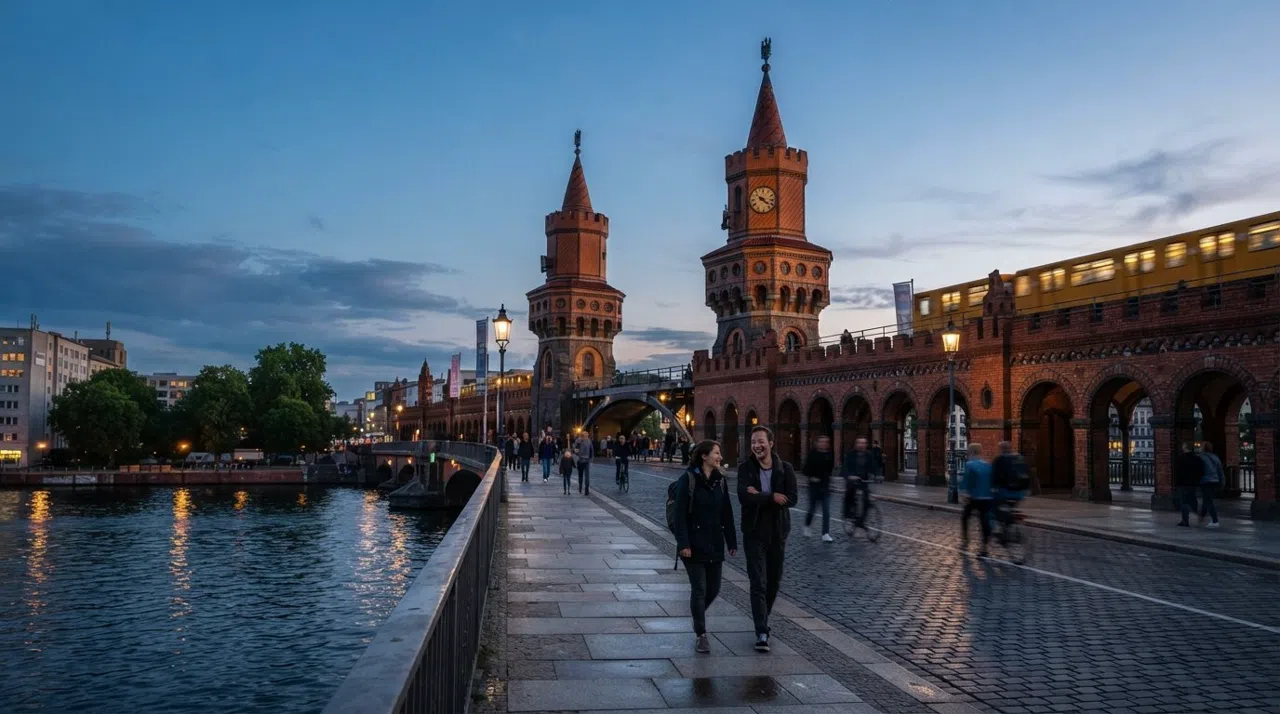
A few steps away, the Oberbaumbrücke is the bridge that gives Friedrichshain its postcard silhouette. It is Berlin’s prettiest bridge, a double-deck brick-Gothic crossing with the U1 running over the top, and it once linked and divided Friedrichshain and Kreuzberg during the Cold War. Mid-span, look up for the neon installation of two hands playing rock-paper-scissors — a small, sly nod to the old East-West rivalry. It’s the sort of detail that makes Berlin feel amused by its own scars.
Then there is the RAW-Gelände on Revaler Straße, the district’s messy beating heart. This former railway repair yard has been turned into a single graffiti-covered block of clubs, bars, beer gardens, a skate park, street-art walls and a Sunday flea market. It is scrappy, loud and gloriously uncurated. That’s the point. The RAW is where Friedrichshain’s alternative reputation stops being a brochure line and becomes a lived-in, beer-spilled reality.
Where to eat & drink
Eating in Friedrichshain is casual, international and mercifully easy on the wallet. The densest cluster sits around Boxhagener Platz — “Boxi” if you want to sound like you’ve been here longer than a weekend — and the streets feeding into it. This is a neighbourhood where you can go from ramen queue to Syrian mezze to a microbrewery pint without ever feeling like you’ve left the same radius.
Niko Niko Ramen on Boxhagener Straße is the cult bowl people line up for. It’s small, it doesn’t take reservations, and there’s often a wait, which in Friedrichshain is less a deterrent than a sign you’ve found the right door. The draw is straightforward: ramen and gyoza, done with enough conviction to make the queue feel like part of the ritual.
Right on the square, Iro Izakaya turns Boxi into a place for grazing rather than sitting down to one thing and leaving. It does Japanese small plates tapas-style, which suits the district’s mood perfectly: a little of this, a little of that, one more drink, then maybe another plate because the night is still young and no one is pretending to be in a hurry.
Aleppo Supper Club on Wühlischstraße, a block from Boxi, is where Friedrichshain’s Syrian cooking strength shows its hand. Mezze and grills are the language here, and the sit-down setting gives the neighbourhood something it occasionally lacks: a sense of pause. It’s a good place to trade the street noise for a table and let the evening stretch a little.
For brunch, Silo Coffee on Gabriel-Max-Straße built its name on a full breakfast plate — poached eggs, avocado, roast potatoes — and serious coffee. The room has the easy, international hum that suits this district so well, and the food does what good brunch should do here: fuel the day without making a spectacle of itself.
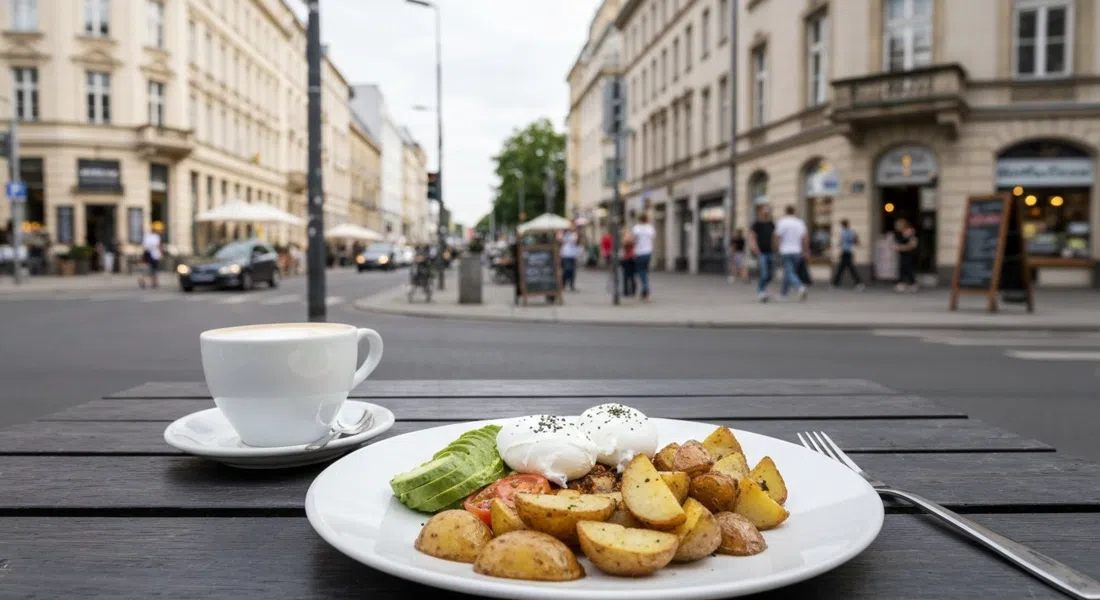
If you want bagels rather than brunch, Fine Bagels inside Shakespeare & Sons on Warschauer Straße is the kind of hybrid that only feels normal in Berlin. The bookshop is English-language; the café hand-rolls proper New-York-style bagels. It’s a useful stop if you’re moving between the station and the river and want something compact, carb-heavy and very much on route.
Beer matters here too. Hops & Barley on Wühlischstraße is a snug microbrewery pouring its own pils, dunkel and cider, and it has the right kind of neighbourhood warmth: the sort of place where a first drink can turn into a second simply because the room feels lived in. A little farther out, Straßenbräu near Ostkreuz runs about ten of its own taps from crisp lagers to fruited sours, and it gives the east side of the district a slightly more taproom feel without losing the easygoing tone.
For a more design-led plate, Michelberger on Warschauer Straße cooks seasonal, produce-driven food from its own farm in Brandenburg. It’s the neighbourhood’s polished counterpoint — still rooted in Friedrichshain, but with a cleaner edge and a bit more intention in the room. Useful when you want dinner before the night properly starts.
Going out
This is why most people come. Friedrichshain has the highest concentration of clubs in Berlin, and the range runs from world-famous to gloriously scrappy. If you’re here for a quiet drink and an early night, the district will probably outlast your plans.
Berghain / Panorama Bar is the name that travels furthest, and it deserves the mythology even if the mythology sometimes gets in the way of the place itself. Built into a former power station on Am Wriezener Bahnhof, near Ostbahnhof, it is the benchmark for hard techno, with house and disco upstairs in Panorama Bar. The door is notoriously strict and unpredictable, phones are not part of the experience inside, and weekends can run from Friday night into Monday. Go late, dress dark, don’t arrive drunk, and don’t perform for the queue. If you make it in, you’re in one of the defining rooms of the city. If you don’t, Friedrichshain has other doors.
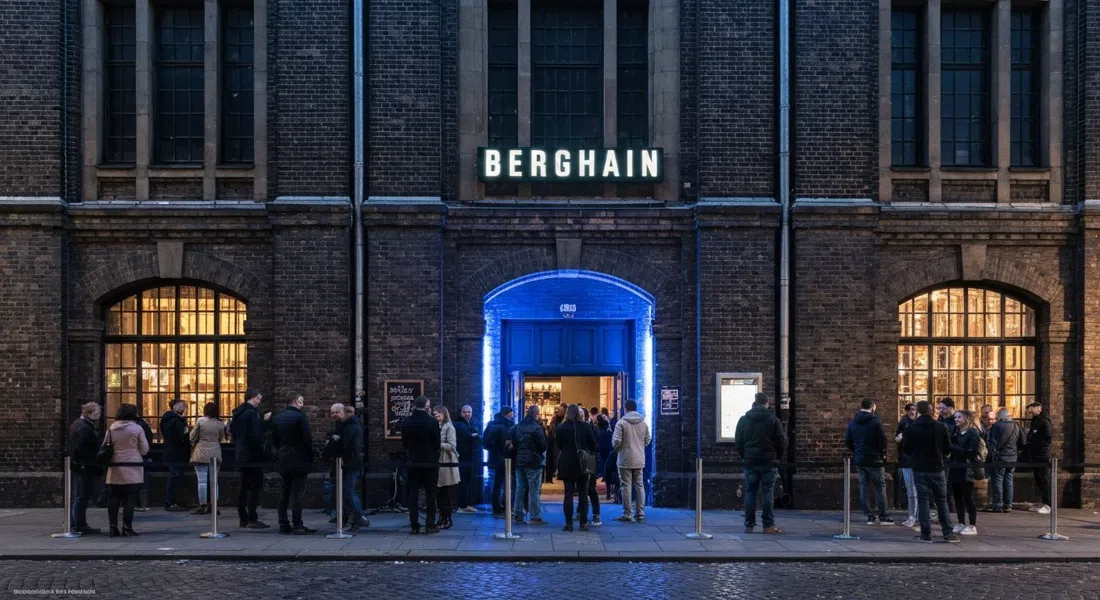
The RAW-Gelände is the more democratic version of the same impulse: several venues packed into one site, each with its own temperament. Cassiopeia gives you multiple floors of punk, indie and electronic, plus a beer garden and climbing wall. Lokschuppen is the hard-techno warehouse at the RAW entrance, successor to Suicide Circus. Crack Bellmer is the relaxed but danceable bar-club on the same site. Together they make the RAW feel like a small city of noise, all within a few steps of each other.
Out along the Spree in Stralau, Wilde Renate is the place for people who enjoy getting pleasantly, slightly lost. It’s a labyrinth of themed rooms and a garden pouring house, disco and techno, and after a nail-biting 2025 it secured its lease into 2026. That matters, because rooms like this are part of the district’s memory bank. They don’t just host nights out; they define how the neighbourhood remembers itself.
Just over the eastern district line in Rummelsburg, Sisyphos at Hauptstraße 15 is for the truly committed: legendary all-weekend open-air parties, the kind that make Sunday feel like a rumour. It’s not casual, and it isn’t meant to be. If Friedrichshain is the district that never quite shuts up, Sisyphos is the proof.
Things to do
Beyond the Wall and the bridge, Friedrichshain has enough daytime substance to fill the hours between clubs. That’s the thing about the area: it can be loud without being one-note. If you stay awake long enough to see it in daylight, the district changes texture rather than character.
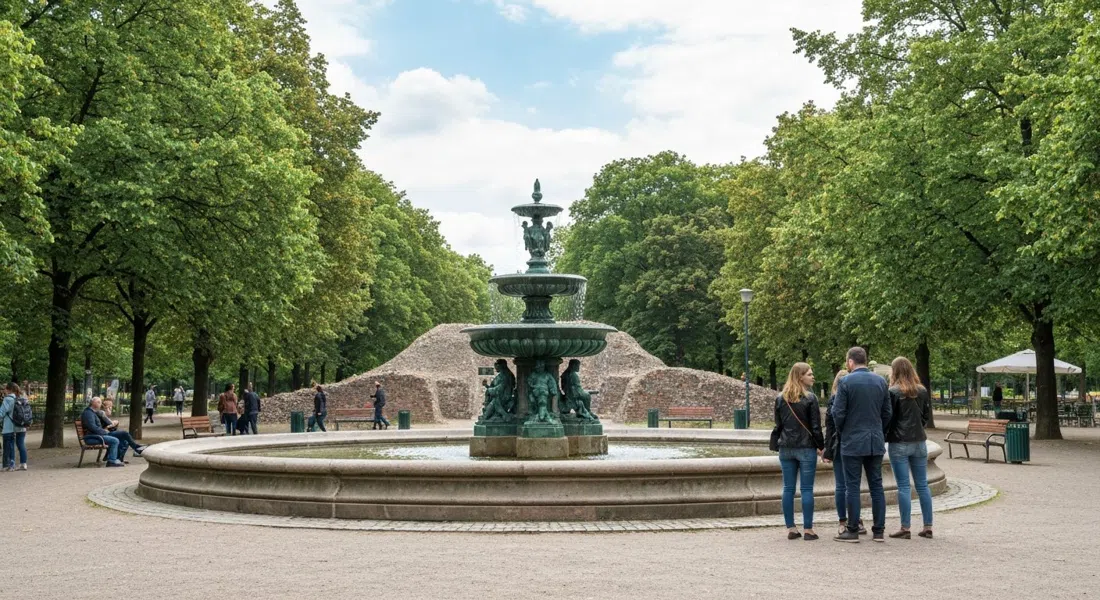
Volkspark Friedrichshain is the oldest public park in Berlin, dating to the 1840s, and it functions like a proper local lung. Joggers loop its paths, people play ping-pong, and the two rubble hills raised from WWII debris give the park a topography that feels both practical and symbolic. The taller one, Mont Klamott, gives you a view. So does the Märchenbrunnen, the Fairy Tale Fountain of 1913, ringed with statues of Brothers Grimm characters. It’s one of those places that reminds you Berlin has always been rebuilding itself in public.
For architecture, walk Karl-Marx-Allee to Frankfurter Tor and let the scale do the talking. This monumental socialist-classicist boulevard was built in the 1950s and lined with tiled workers’ palaces, all leading up to the twin towers at Frankfurter Tor. It is one of the most complete pieces of GDR urbanism anywhere, and the contrast with Friedrichshain’s scruffier side streets is exactly the point. One minute you’re in a grand ideological stage set; a few blocks later you’re back among stickers, bicycles and late-night kebab wrappers.
The East Side Gallery doubles as a riverside walk, which means you can stitch together a self-guided stroll that takes in the district’s most recognisable landmarks without ever feeling like you’re doing homework. Start by the wall, drift toward the Oberbaumbrücke, and keep going if you want the Spree as your companion. It’s one of the easiest ways to understand Friedrichshain’s geography: water on one side, history on the other, and the present tense somewhere in the middle.
Shopping & markets
Friedrichshain shopping is about independents and markets rather than chains. The anchor is Boxhagener Platz, where the square changes character with the calendar. On Saturday, there’s a farmers’ market for produce and street food, roughly until mid-afternoon. On Sunday, a flea market runs from around 10am to 6pm, and the square fills with stalls of vinyl, books, vintage clothes and bric-a-brac. It’s not a polished market; it’s a rummage, and that’s why people like it.
The streets radiating off Boxi — Krossener Straße, Grünberger Straße, Gabriel-Max-Straße — hide small fashion and design shops, record stores, secondhand rails and gift shops. Maerz on Krossener Straße stocks labels like Wood Wood, while Grünberger Weinhandlung on Grünberger Straße is the long-standing neighbourhood wine merchant, the sort of place that makes browsing feel like part of the district’s daily rhythm rather than an errand.
Book lovers should make for Shakespeare & Sons on Warschauer Straße, the English-language bookshop that doubles as the Fine Bagels café. It’s one of those useful Friedrichshain combinations that makes the neighbourhood feel practical as well as playful: buy a book, eat a bagel, watch the street move outside.
The RAW-Gelände also hosts a grittier flea market on Sundays, and if the Boxi market is the neighbourhood at its most domestic, RAW is it at its most unruly. Same impulse, different volume.
Where to stay in Friedrichshain
Where you sleep here is a trade-off between buzz and rest. Around Boxhagener Platz and the streets off it — Simon-Dach-Straße, Wühlischstraße, Gabriel-Max-Straße — you get the sweet spot: cafés, bars and markets on the doorstep, a genuinely residential feel, and still an easy walk or short tram to the nightlife. The catch is obvious enough: weekend noise on the busier bar streets, and not much point pretending otherwise.
Closer to Warschauer Straße and the Spree, you are right on top of the RAW clubs, the East Side Gallery and the transport hub. Brilliant for clubbers; less ideal if you value quiet. This is where the Michelberger hotel sits, which tells you everything about the strip’s appeal — design-led, well connected, and perfectly placed for people who want to move between dinner, a queue and the first tram home without changing neighbourhoods.
Toward Frankfurter Tor and Karl-Marx-Allee, things calm down. The streets feel more local, the pace drops a notch, and the U-Bahn links keep you connected to the rest of the city without forcing you to live in the thick of it. Prices skew affordable by Berlin standards, with plenty of hostels, apartment rentals and mid-range hotels rather than luxury names.
Getting around
Friedrichshain is compact and best explored on foot. You can walk the East Side Gallery, the RAW and Boxhagener Platz in an afternoon without breaking much of a sweat, and that’s the best way to understand how the district works: not as a set of attractions, but as a sequence of moods.
Warschauer Straße is the main gateway, with U1/U3, S-Bahn and the terminus of the M10 tram all within a couple of minutes’ walk of the RAW and the East Side Gallery. Ostkreuz, on the district’s eastern side, is a huge S-Bahn interchange including the Ringbahn (S41/S42). Frankfurter Tor puts you on the U5 with tram connections. The M10 tram — nicknamed the party tram — threads the nightlife strip toward Prenzlauer Berg and Hauptbahnhof and runs 24 hours like all MetroTram lines, which makes it invaluable at 4am when the queue has finally emptied and everyone else is trying to remember the route home.
Mitte and Alexanderplatz are only about 10–15 minutes away by U-Bahn or S-Bahn, which is part of why Friedrichshain works so well as a base: you get the grit and the noise, but the centre is still close enough to feel like a quick diversion rather than a commitment. For the airport, take the S-Bahn or regional train from Ostkreuz or Ostbahnhof to BER — reckon on roughly 30–45 minutes.
The practical truth is simple. Friedrichshain is lively and generally safe, with the usual big-city awareness around the RAW-Gelände and busy bar streets late at night, and you should mind your belongings in crowds at markets and clubs. But if you want Berlin with its sleeves rolled up — the Wall, the queues, the cheap plates, the tram bells, the bass bleeding through a warehouse wall — this is the district that still feels most like itself.